Tuesday, June 11, 2013

I. Rusty Narratives: Reporting the Events


I think it’s no longer necessary, at this point, to go into details of the actual events that have unfolded in the last two weeks. Anyone who is not up to speed can check out this helpful timeline or this cute infographic.

The comments I want to make are in response to some common misinterpretations by the international media. Every one of these pitfalls can conveniently be found in this piece by Paul Mason. In his article, Mason manages to share a somewhat insightful anecdote about tear gas, and deserves credit for getting the name of the trees in the park right, but as for the rest - it’s hard to believe he actually came here and spoke to anyone actually involved in the protests given his superficial analysis, stereotypes and mischaracterisation. 

1.       “Will gas canisters or yoga prevail in Turkish spring?”

Catchy title, admittedly, shame about the reference to a “Turkish spring,” which the protesters have expressed their objections to repeatedly. Let’s not kid ourselves, Erdoğan won several elections and even those fiercely opposed to his politics, such as the Greens and Left for the Future Party, admit that his government has pursued some commendable policies, as the party’s International Secretary, Ahmet Atil Asıcı, pointed out in his statement:

“The ruling Justice and Development Party (AKP) has long been viewed as a progressive party and indeed it was so until recent months. The AKP was successful in enriching ordinary people materially. GDP per capita increased relentlessly since the AKP took the office in 2003. […] This economic success was reflected in the support of people in the latest election which gave the AKP the support of 51 percent of votes. The peace process initiated with the Kurdish movement, to resolve a conflict which took the lives of 50,000 people in the last 30 years, also gained widespread support from the public.”

The cries of “Hükümet Istifa” (Goverment Resign) that echo around the city are more a rallying cry than a genuine demand. This isn’t about a revolution. Protesters don’t want another coup. They want a democracy that works, that rules by consensus not ruthless & posturing majoritarianism and that listens to its citizens. As one correspondent pointed out – there is no spring here in Turkey, it’s summer.

As for the “occupy” label, it is of course still an imperfect comparison, despite having been appropriated by the protesters themselves. I find the recent comparison of Gwynne Dyer to the Paris May ’68 events rather compelling, but I do also wish we could just see the events as unique and context-specific.

2.       “I have seen all this before - in Syntagma Square in Greece, among the Spanish indignados, on the roundabout in Tahrir Square.”

No. No you haven’t. This is not Tahrir Square, for the reasons stated above (I’d also venture to say that the amount of sexual abuse and harassment of women that has taken place in Taksim is a minute proportion of that which went on in Tahrir). As for Greece, the climate of austerity has nothing to do with the economic context in Turkey, which until recently has been growing at breakneck speed and certainly hasn’t seen anything like the kind of economic nose-dive taken by its neighbour. And as for Spain – I can’t even be bothered...   

3.       “The secular, urban, educated, young are a political minority in Turkey.”

Actually most of them are not political at all. Some of the kids I’ve seen taking to the streets, braving the gas and standing vigil day and night in the square and the park, have surprised me by the force of their determination and the intensity of their feelings given their lack of any political affiliation or even particular interest in politics. The alliance that has emerged between feminists, ecologists, Kemalists, nationalists, football fans, and many others has been a source of amazement. Many of those who put themselves at risk by getting deeply involved in the protests were not waving a political flag but rather belonged to associations of physicians or lawyers, for example.
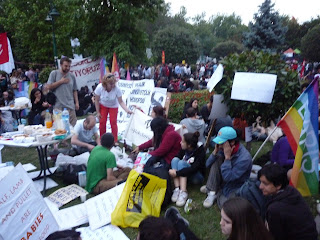


There is a question about the politics of the protests, of course. Government supporters have attempted to undermine them by saying that tensions between different factions in the park are already causing the happy alliance to implode. This is an exaggeration, and by and large everybody has co-existed with admirable tolerance, but there have been tensions, and the occasional scuffle, especially when it comes to symbols like the Kurdish flag or the face of Öcalan (jailed PKK leader), which has proved to be just too much for some nationalists. In the historical context, this is in no way surprising, of course, given the levels of seething hatred that exist there.  

4.       “In Alifuatpasa, the women do not wear skimpy tops, or yoga pants, but in fact the veil and clothes that cover them head to toe.”

With this and several other quotes, Mason seems to fall into the same trap as many other commentators who have understood & portrayed the protests through the prism of the old Islamist vs. Kemalist dichotomy.

When I visited Gezi Park before the crackdown of Friday May 31st, there were no flags to be seen, and the lack of symbols gave the real sense of a civil movement, composed of individuals who wanted to save their local park by peacefully camping out there. Participating groups such as the Greens left their flags at home purposefully to avoid engaging in any political opportunism.

In the days that followed the police’s absolutely shocking attack, when masses of people started to gather in the park and square, and to march through the streets of districts across the city and across the country, when people started standing at their windows banging pots and pans and flashing lights on and off to demonstrate their consternation, that’s when the flags came out.  And boy did they come out. Especially the Turkish flag, of course, sometimes featuring Atatürk’s face, and often accompanied by chants like “We are the soldiers of Mustafa Kemal.” There have been attempts to clear the protests of divisive symbols, but often these have excluded the Turkish flag, which for me misses the point completely. Turkish citizens cannot be united under a flag which for decades has been emblematic of the oppression of so many minorities – Greek, Kurdish, Armenian, Alevi – etc. [This is a small digression which is only my personal opinion, and which I know many of my Turkish friends would disagree with.]

Essentially, the presence of many devout Muslims, and indeed quite a few AKP voters, among the protesters is proof that this old framework is inadequate for making sense of what is now happening. There is no indication that any party, for example the Kemalist CHP (Republican People’s Party), will gain from this politically. Nor is this a movement which alienates Muslims, although of course the staunch supporters of Erdoğan’s brand of “political Islam” are less likely to support the protests.  

II. Information Pollution: Navigating the treacherous waters of social media


Since the protests began I have acquired a veritable wealth of new vocabulary. The chants, the graffiti, the analysis, the tweets – all have provided a flood of new terms to get my head around. The most overheard one I think has to be “şerefsiz orospu çocuğu” (shameless son of a whore). But one of the most memorable I’ve come across was the concept of “bilgi kirliliği” – translated literally as “information pollution” and meaning the corruption of information, in other words falsehoods and hearsay masquerading as truths or objective facts.

I first saw this applied after a friend of mine posted a photo of a man with horrific back injuries, alongside a caption claiming it showed a protester who had been run over by a TOMA (armoured vehicle). This may well have been the source of the injuries depicted – but it had nothing to do with Turkey or these particular protests.

I have to come clean and admit that, despite my best intentions, I failed miserably to follow my own advice of using social media in a calm and responsible fashion when dealing with the protests, to avoid spreading misinformation and exaggeration and to share only confirmed facts and content. This seems to me crucial if social media is to be a useful alternative to traditional media, especially when the latter is plagued by censorship and pro-government bias, as well as to avoid doing harm to our own cause by spreading panic or lies. But in the end, I also found myself caught up in the digital histrionics. I made two textbook errors which I deeply regret.

The first was sharing a photo that had been widely circulating, which showed the Bosphorus Bridge absolutely filled with people, and captioned as showing protestors crossing the bridge on foot to get to Taksim from the Asian side of Istanbul after public transport was suspended. It was in fact a photo from a previous marathon in the city.

The second was more serious, but in a way more easily justified. I had been supposed to meet a friend in Taksim Square on Saturday June 1, a day after the big crackdown, but he got caught up in the police’s assault on protesters in Beşiktaş. He texted me later on to say what had happened, explaining how they had thrown tear gas in all directions, that he had gone blind for 5 minutes as a result, and had to rely on strangers to guide him as he fled from police. He added that police had been using an “orange gas” and I, idiotically, took to social media to announce that Agent Orange was being used. The reason I say that this was more easily justified is because I felt quite shaken at the time and was deeply affected by it. When your friends are being tear-gassed and attacked for no reason, you want the world to know. When anger and emotion take over from rational consideration, this is when the slippages are most likely to occur. 

They are also symptomatic of the frustration borne out of the lack of access to any trustworthy sources of information. We were starved of information, by the main broadcasters and by politicians, who made statements talking about dozens of injured people when it was patently thousands. We could not confirm or deny anything. This was the time when the alternative news sources – which streamed live footage from the sites of the protests, really came into their own. But even these often suffered from a lack of accompanying commentary or analysis to be able to apprehend exactly what was going on.

None of this excuses the mistakes, of course.* I would like to think that I’ve learned my lesson and wouldn’t make the same errors of judgement again. I resolved to trust only what I had seen with my own eyes or heard directly from trusted eyewitness accounts, but of course you can't be everywhere at once, and the constant flow of information pouring in is at once terrifying by its volume and unpredictability, but also addictive. I have never been such an avid user of social media as I have over the past two weeks. I suppose the only thing to do, even when enraged and frightened, is to take a deep breath, count to ten, and try to make as certain as possible, before clicking, that confirmed really does mean confirmed.

*Then again, some cases are rather exceptional, my newspaper – the Hürriyet Daily News – reported on June 5th, that the death toll had risen to 3. It later published an article saying that the death toll remained at two, while the third was merely brain-dead. Crying Agent Orange is bound to cause panic and chaos, but it seems to me that reporting brain death as actual death is the least of sins under the circumstances.   

III. Kind of about a park: The personal account


I disagree with the foreign residents in this city who’ve kept away from the resistance, saying this is not their struggle. These issues are not restricted to Turkey and the support appears to be highly appreciated by the protesters. But I can’t claim to understand exactly what is happening. While in previous crackdowns, such as on May day, people seemed to agree that the protesters were basically trouble-makers, now something has switched completely. Despite the media censorship, there has been a massive outpouring of anger. People who work hard all day have been spending their evenings, if not nights, in the Park to support the protests, even those who are not remotely political. It’s been amazing to witness and even more amazing to be a part of.

Protesters and onlookers alike have repeated time and time again that “this is not just about a park.” Indeed, it’s true in the sense that a suspension of the plans to demolish Gezi Park alone would not address the underlying issues (but it would be a start). But I don’t think we need to go too far the other way. Gezi Park is, after all, where it all started. So it is sort of about a park... And this is something that has made the protests seem all the more innocent and vulnerable, and the brutality of the police all the more shocking. When I first went to Gezi Park to support the protesters, some two weeks ago, it was a decent-sized gathering of people with a few flimsy-looking tents strewn about the grass. While we sat and had a drink, someone walked around with a megaphone urging people to stay, not just to be in the park for the evening and then leave. They knew what was coming, of course. At the crack of dawn, police bulldozed their way in, and began tear-gassing people and burning tents. People were understandably outraged. I went back two nights later and the presence in the park was tenfold what it had been before. There were banners bearing slogans, pictures caricaturing Erdoğan, and plenty of people, jovially and of course ironically raising their beers in toasts to him. More importantly, there were many more tents, and far sturdier looking ones. The atmosphere was one of defiance and celebration. I went home feeling reassured. There is no way they’ll attack tonight, I said to my flatmate, not with so many people there. That was Thursday May 30th. The big crackdown happened the next morning. I woke up to nightmarish scenes of violence and chaos. It went on all day and well into the night. That was the night CNNTurk decided to broadcast a documentary about penguins. The night the banging of pots and pans began.  

On Saturday I kept out of the way. In the afternoon we heard that the police had withdrawn (but had no idea for how long). I decided to head down and see what was going on. I had friends who were already in Taksim Square, and thought if I could just make it to the square, I’d be ok. So I put some lemons and a scarf in my backpack and set off. No buses were going down the road towards Taksim, and the metro had been stopped, so the only option was to walk. The road was packed with people, almost all wearing gas masks, and at a certain point the cars stopped and the road became effectively pedestrian. It was getting dark by the time I drew up to the park. I stood by the outside for a while, trying to muster the courage to go in. Some boys were rolling a massive concrete pipe across the road to build a barricade. They stopped to let me pass, with a courtesy that seemed surreal under the circumstances. I panicked about the idea of being trapped inside with no way out, so stalled by the edge a while longer... when I did finally set foot inside the park, it was packed. People were making passionate speeches, and cheering. In the distance I could hear loud bangs. I bottled it and turned back.

Gezi Park 01/06/13

On Sunday I went back, and made it to the square this time. There was a lot of damage around, but all the tension had been released from the atmosphere. It felt so good to stand in Taksim and feel safe again.

Except it’s not safe. Even now. Although Gezi Park and Taksim have become little havens of peacefulness, where people look after each other, share their food, donate books to libraries, put up humorous placards and engage in all kinds of other exemplary and heart-warming behaviour that makes Erdoğan’s characterisation of them as “marauders” all the more absurd, the threat of a repeat of May 31 still looms. The plans to demolish the park haven’t been called off. Erdoğan’s rhetoric is increasingly menacing and provocative.

Peaceful protests are not seen as legitimate by this government and its supporters. People who occupy public spaces are seen as fundamentally threatening and disruptive. This is the justification for the ruthless onslaughts by police against what are generally unarmed young kids. They are out for blood, as if they’ve been instructed so. They aim tear gas canisters at people’s heads; they fire water cannon at close range. They do not simply allow a crowd to disperse, they chase people into closed areas from which they cannot escape and attack them with unbelievable quantities of tear gas, even if that means throwing tear gas directly into people’s homes. They tell people they can come out safely and then start beating and arresting them. This violence is regarded as a “legitimate” response to an illegitimate form of protest – namely, occupying the public space when you’ve been told not to. This is where the fear comes from. And it’s all-pervasive. Even though Turks become have largely become accustomed to tear gas, as a result of its generous usage, the fear remains.  

I do not recognize anything about the Turkey I know and love in the behaviour of these “security” forces. In a society where everyone addresses and treats others like members of extended family, it is as if the bonds which bind people together have been eroded somehow, as this harrowing account shows.

It is in such diametrical opposition to the attitude most Turks seem to adopt on a daily basis, but which we have seen especially during the last weeks. People putting themselves at risk to help each other out, displaying incredible selflessness and solidarity with each other. Like the people who opened their homes or shops to protesters being pursued, or the old people who left lemon and vinegar on their windowsills for those affected by the gas. The doctors and lawyers who've given up their time and energy to help the injured and those under arrest. This was also my experience when I walked straight into a confrontation between police & protesters outside near my house on May Day. When the tear gas lobbing started an old man noticed my alarm, and shared his water with me.  

I’ve heard several people say that these events have restored their faith and hope in the future of their country and its people. Before these events, I loved Turkey and especially Istanbul and there was nowhere in the world I’d rather have lived. But I was saddened by certain tendencies I was witnessing. Primarily the tendency toward massive commercialization, with an apparent total disregard for the environment and the local. And the gradual erosion of people’s hard-won personal freedoms, such as drinking alcohol or kissing on the metro, which Erdoğan has declared war on in his quest to raise a new generation of “religious youth,” who abstain from alcohol, who do not go on strike or protest or engage in any other kind of civil disobedience, who never show affection in public, who essentially work hard and consume hard and have at least 3 children.

This point about pushing for a consumer society is crucial, so that they can be good enough consumers to allow the country to reach the government’s goal of being in the top 10 economies by 2023. I say goal, it seems more of an obsession. In the pursuit of which no sacrifice is too great, even if it tears through ecosystems and ruins livelihoods.

There is a kind of civil engineering behind this, beyond the underlying capitalist ideology. The constant eating up of green spaces to make way for franchise cafes and shopping centres. It makes it impossible for people to spend their leisure time outside their homes without spending money. Yes there are massive forests outside the city, and no they are not accessible unless you have a car and at least a half or preferably a full day at your disposal. This policy of the government’s has been ruthlessly effective. The malls and Starbucks’s are full, for those who can afford it. And for those who can’t, there is a need to find creative – though sometimes perilous – solutions. It breaks my heart to see entire families sitting down for a picnic on a Sunday on one of the tiny little islands of grass surrounded by motorways, simply because it is the only green space around.     

This has proved that Turkish people do not want to be herded into being productive and obedient consumers. They value much more important things, like the environment, culture, heritage, freedom, choice, and tolerance. And they are even willing to put themselves at risk to defend those things. I just wish so desperately they could live in the kind of society and the country that they deserve to live in.

Please support the protests by taking part in a solidarity action near you.

The links below provide useful information, commentary and background:
Taksim Solidarity Platform Manifesto

Wednesday, April 20, 2011

Another day another victory for a xenophobic nationalist party in Europe.

They're dropping like flies. The latest victim to succumb to the smooth-talking bigots is Finland, that mysterious country I've always wanted to move to, for literally no other reason than being inexplicably but desperately in love with the sound of the language.

I'm beginning to think the prophecy might be about to come true. That's the prophecy that Ariyeh King, uber-zionist and founder of the Israel Land Fund (which organizes the building of illegal Israeli settlements on Palestinian land), made during our discussion in the pleasant and leafy courtyard of the American Colony Hotel in Jerusalem.

In King's estimation, the levels of discrimination and division that exist in Israel, though they would make the founders of apartheid proud, will soon appear moderate in comparison to the massive scale of racism within Europe. This phenomenon, he predicts, will eventually culminate in a full-scale expulsion of immigrants (islamic, essentially) or even, presumably in the case where they fail to go quietly, “a war”.


To back up this contentious proposal, he cited the bans on minarets in Switzerland, and on the veil in France. But he didn't have to stop there. He could also have mentioned the creeping banalisation of the far-right discourse in the UK (English Defence League "spokesperson" invited onto Newsnight, and then allowed to leave freely afterwards?). Or even the way that European countries like France, Austria and Germany, those great shining beacons of human rights, have pulled up the drawbridges, shut their borders and told trains carrying migrants from North Africa to kindly go back from whence they came (unfortunately for them that was Italy - the country that either allows migrants to drown in the sea, or uses military weapons to prevent them from entering).

The case of the French burka law is particularly staggering. Apart from the fact that virtually every other type of face-covering conceivable appeared to be exempt from the law, I must confess I fail to understand the logic by which making the wearing of an item of clothing into a political offence empowers muslim women and instantly frees them from the complex social and religious structures of oppression that hold them back. Although it did clearly succeed in empowering the two women in burkas who promptly went out and got arrested. Good for them, standing up for themselves, exercising their right to protest, that's what freedom is all about!

Because that was the point, right? It wasn't just about legitimising a pernicious perspective whereby people who do things a bit differently and don't look like the majority are automatically flouting, and engaged in a lifestyle totally incompatible with, the fundamental values upon which the republic was founded, was it? Or was it a pathetic last-ditch attempt by Sarkozy to drag up the opinion poll ratings a notch or two before the election campaigns get underway? No, probably and yes, respectively, would be my guesses.

Suffice to say, there is no shortage of reasons not to be cheerful. The lies, the racism, the political opportunism of it all is, like, wow. But when has it been any other way, in Europe…

Still. No amount of relativising matters historically makes it possible to stomach anti-immigrant politicians bemoaning the relentless influx of scroungers and criminals into their previously edenic nations, who are then treated like privileged citizens to the detriment of the white working-class (especially male, weirdly enough) population. While at the same time barely adult victims of sex-trafiking are being deported. Wonder what demographic of society is generally driving this trade by frequenting these kinds of girls? Hmm, on the other hand, perhaps best not to...

I have to commend the Guardian for helping to raise awareness recently of just some of the projects, organisations and charities that are going to get axed by the cuts. Given the way David Cameron's government has run its operations so far one might be tempted to think they're doing it on purpose, actively seeking to elicit as much outrage as possible at their attempts to destroy the social fabric of absolutely everything in an attempt to shake us out of our complacency and remind us what's important in society, what needs protecting.

So maybe we'll have to wait it out. For a few more nationalists to celebrate their landslide victories, and a few more fascist lunatics to get scarily close, to the point where things have gotten so bad that nobody can get away with ridiculous arguments about politics correctness gone made or immigrants being treated like royalty. To the point where one day Europeans wake up and realise that they are putting the Israelis to shame. That for all their routine violations of the basic rights of Palestinians, bulldozing through houses and cutting off water supplies, they look like care-bears compared to the bigoted, racist pieces of work leading most European countries.

Maybe then we'll remember why it was so important to fear racism.

Wednesday, April 06, 2011

The Problem with Public Displays of Integrity

Two peculiar instances of apparent about-turns caught my eye recently. In the case of Richard Goldstone and the report into Cast Lead, it is the timing that is surprising. In the case of George Monbiot's sudden penchant for nuclear energy, it is strength of the statements he's made in its defence that seems uncanny. It's almost enough to make one suspect the "other side" got to them in some way, especially knowing who those sides are.

Monbiot's trajectory began with an article hinting that nuclear power may not be so bad after all, followed by a piece in which he as an individual came out in active support of it, and now by a piece in which he denounced members of a movement to which he once belonged for not being completely coherent.

Monbiot dismisses the arguments made by John Vidal, in response to his previous article, on the basis that he doesn't provide irrefutable evidence of linkages between the phenomena that were and still are observable in the region surrounding the Tchernobyl powerplant, and the meltdown of this plant.

I'm not a scientist, but I have it on a good authority that there are many linkages between phenomena that cannot be fully explained, yet all the evidence suggests the link is there. A number of medical treatments, for instance, are prescribed on the basis that they work - but we don't know yet quite how they work.

I may have found the anti-nuclear campaigners' response to Japan tactless but Monbiot's accusations of deliberately misleading people seems a step too far.

And yet I understand why he did it. The Green movement is one that has many principles. Within its ranks are individuals who admirably hold themselves to very high ethical standards. To an extent which I think it pretty much unique. Monbiot's response to what he regarded as misrepresentation of "the facts" has reinforced this opinion.

But it's also bloody stupid. Stupid, I mean, to admit weaknesses in public, to confess to nagging doubts and open criticisms in the face of such powerful forces who tend to interpret these matters in black and white terms, for their own interests.

As if the nuclear industry or the ruling class in Israel are whiter than white in their own representations. Politicians and the media, not to mention private companies, routinely distort and manipulate information for any number of reasons. Does Monbiot feel that environmental campaigners are so well placed, or their views so dominant, that they can afford to be undermined by giving their opponents such gifts? Knowing, of course, that these opponents would never do the same for them and knowing also how, unfortunately, public debate often fails to take into account the nuances of such arguments, but rather zooms in on the headlines, the soundbites, and runs with them.

Being exposed to some of the Israeli press concerning Goldstone's qualification of the earlier report, at the time, allowed me to gain some insight into the way it was interpreted by the media and politicians there. Namely, that it was immediately seized upon as evidence that the whole report was flawed and invalid, regarding this admission as equating to a revocation of the entire report, and, in the words of Netanyahu, confining it to the "dustbin of history". However educated and refined these individuals no doubt are, the level of appreciation for nuance here is clear.

No doubt the nuclear industry & its lobbies are not far behind, driven as they are by stakeholders and profit, rather than a long-term vision for the perpetuation of the planet, as is the case for environmentalists.

This article commended Goldstone for his statement, describing him as "a man of integrity and independence... It's the easiest thing in the world to stay silent; to come out in this very public fashion is a brave act."

I agree with this. I think it is absolutely the right and correct thing to do. I admire fervently the integrity of those who admit their weaknesses and mistakes in public without being pushed. They are few and far between. But I have to ask - what is the use, when they are not greeted with reflection and willingness to compromise, but rather manipulated and taken out of context as a total victory for those being criticised?

My argument, and it is a practical one for an un-ideal world, is that such admissions should be confined to within the ranks of an organisation or movement, in such circumstances. In this way, the aims of integrity and consistency can be acheieved, and mistakes can be learned from.

But there is also a question of responsability here, not only utility. It is not just about protecting credibility and political reputations. It is also about refraining from handing such criticisms over to those who would use them to the detriment of others.

So in we went.

At this point I've heard compelling arguments from both sides. Off the top of my head, I'd be fascinated to hear Daniel Cohn-Bendit debate Simon Jenkins on the question.

There's those who want to draw lessons from Iraq, those who'd sooner look to Bosnia, and all the various other precedents that've been mobilised to support a particular course of action, or inaction. When we can't seem to agree which history it is that we do not want to repeat, taking a clear moral position becomes tricky.

In such morally ambiguous situations, one feels small. I certainly do, and so this post isn't meant to be a political "prise de position" based on which stance is more ethical. But on that note - quick parenthesis - although I wouldnt align myself with it completely, perhaps it's worth recalling Chomsky's view of Obama. It may sound cynical but to me it's an alarming reminder of fears voiced by some back in 2008 that under the Obama administration "regime change" and power politics would be rebranded and acquire a renewed legitimacy after the Bush era. Just in passing.

Actually, I'd rather keep my distances and comment instead on a particular aspect of the semantics of the coverage and the debate, such as it comes across to me, at least.

At the same time as European nations are intervening and putting the lives of some of their own citizens at risk for the people of North Africa - this is occuring.

Is it contradictory that navy ships sent to help the rebels are also blocking escaping boats, or that democratic countries that happen to be in the south of Europe allow immigrants to drown at paddling distance from their shores? I think so.
It seems that the situation in Libya is one of at least two pivotal events currently unfolding in the world informed by this syndrome.

In the case of Libya, I think this work of mental abstraction operates in a somewhat incoherent way. If we see people in collective terms then there's two big sets - the heroic figures of the revolution - the protestors risking everything fighting for freedom, who are admired, as opposed to the hordes of asylum-seekers whom we fear and dread.

The process of abstraction which turns individuals into statistics or "illegalises" them, is encouraged and even made inevitable by the political language that characterises the debate about immigration. Like all discourses, it is far from innocuous, but I'd say this one is particularly corrosive.

In her article "Welcome to Britain: the cultural politics of asylum", Imogen Tyler makes a number of very important points about the rhetoric surrounding immigration. The popularisation and banalisation of the term "asylum seeker", as essentially a synonym for a scrounger or a criminal, has been encouraged by mainstream political parties and taken up by most of the media. The worst xenophobic discourses (found in tabloids largely) depict the asylum-seeker as a dehumanised, undifferentiated foreign mass or influx.

The figure of the asylum-seeker invokes the "non-status" of a person who has not been recognised as a refugee - someone who is literally pending recognition. Tyler argues that "inscribing the category of asylum-seeker in British law through the enactment of a series of punitive asylum laws has enabled the British government to manoeuvre around the rights of the refugee as prescribed by international law."

This discourse then identifies and excludes individuals as asylum-seekers on the one hand, and secures the imaginary borders of nations and shores up a normative fantasy of national identity on the other. It also conveniently obscures all the complexity of the phenomenon.

Interestingly, Tyler also speaks of the tension that exists between the urgency of staking a political claim (on behalf of asylum-seekers, for example) and the need to reflect critically on the language in which those claims are made. In other words, although the way politicians and NGOs formulate their arguments and responses may be to some extent complicit with the xenophobic discourses, sometimes the humanitarian urgency is such that there is little time to reconfigure the terms of the debate. I think this is pertinent to the case of Libya where, while the critical thinkers are reflecting sociologically about the terms of the debate, Gadaffi is busy massacring his people. Dilemma.

So I won't denounce the intervention. I will save my condemnations for Marine Le Pen, who went to Lampedusa last week. It's a bit like if Bruno Gollnisch went to visit Auschwitz. It's like when Nicolas Sarkozy went to Turkey. It's an insult. A calculated, cynical insult, designed to impress domestic audiences and win brownie points with voters at home. Incidentally the most conservative, reactionary, racist breed of voters.

The fact that people respond to major catastrophes in the manner described by Chakrabortty means that so often, international crises are met by domestic responses. This seems to me the way that many responded to the nuclear crisis in Japan. In Libya, there is a disconnect between the two responses. It does not add up to declare unflinching support for citizens in a country and yet treat those fleeing danger as potential criminals. We need to connect the dots, and fast.

(UPDATE: This article is very insightful about the way Italy in particular frames the question of immigration in terms of security and criminality, requiring a military rather than humanitarian response)